
Top 10 Mistakes WAEC Candidates Make and How to Avoid Them.
If you are preparing for WAEC right now, this article might just be the most important thing you read before that examination day. Not because it contains magic formulas or special “expo”, but because it is going to show you the exact things that are silently killing candidates’ results year after year.
And trust me, the numbers are not pretty.
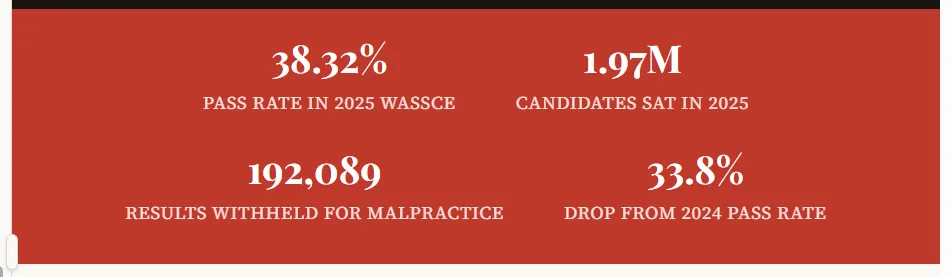
In 2025, over 1.9 million candidates sat for the West African Senior School Certificate Examination (WASSCE). Out of all those students, only 38.32 percent, that is, less than 4 out of every 10 candidates, obtained the minimum five credits, including English Language and Mathematics, needed for university admission. That is the worst performance Nigeria has recorded in over a decade, and it dropped from 72.12 percent the previous year.
So what happened? Were the questions harder? Did everyone suddenly forget how to read?
No. What happened was simple: WAEC tightened their anti-malpractice measures, serialised their objective papers, and the results exposed just how many candidates were not genuinely prepared. The crutches were removed, and many people fell.
But here is the good news, every single mistake responsible for those failures is avoidable. This article will walk you through the top 10 mistakes WAEC candidates make, why they happen, and exactly what you need to do instead to not fail like them in the 2026 WASSCE.
Let us get into it.
Top 10 Mistakes WAEC Candidates Make and How to Avoid Them in WASSCE 2026
Below are the carefully selected 10 mistakes WAEC candidates make and how you can actually avoid them this year.
1. Ignoring the Official WAEC Syllabus
This one is number one for a reason. It is the most common and most damaging mistake candidates make, and yet so many students are not even aware they are doing it.
Here is how it usually goes: a student gets their textbooks, opens to page one, and starts reading from chapter one to the end, hoping that by the time exam day arrives, they will have covered “everything.” The problem? Nobody told them that WAEC does not test everything in the textbook. WAEC tests what is in the syllabus.
The WAEC syllabus is literally a document that tells you topic by topic, section by section, exactly what can and cannot appear in your examination. It is publicly available, it is free, and it is the single most important study tool for any serious candidate. If you study outside the syllabus, you are wasting your time. It is as simple as that.
What to do instead: Download the WAEC syllabus for every subject you are sitting. You can get them from the WAEC official website or from accredited bookshops. Before you open any textbook, go through the syllabus first and build your study plan around it. That way, every hour you spend studying is a targeted hour — not a guess.
2. Not Practising With Past Questions
This is the second biggest mistake, and it goes hand in hand with the first one.
Some students study their notes, understand their textbooks, feel prepared — and then walk into the exam hall and freeze. Why? Because they have never seen how WAEC actually asks questions. They know the content but they do not know the format, the language, or the pattern.
WAEC is not a random examination. The same topics repeat. The same question styles appear again and again. Candidates who have solved five or more years of past questions before their exam date already know what to expect — they have seen similar questions before, they understand how marks are allocated, and they know which areas consistently show up.
Practising past questions also does something else that most people overlook: it trains you to think under pressure. Knowing something in your room is very different from producing it correctly in an exam hall with a clock ticking.
What to do instead: Make past questions a non-negotiable part of your preparation. Solve at least five years of past questions for every subject, and do it under timed conditions — meaning you set a timer and attempt the paper as if you are in the actual exam hall. After each session, check your answers against the marking scheme and study every question you got wrong. That is where the real learning happens.
3. Poor Time Management During the Exam
You can know every single thing in that exam paper and still fail — if you do not manage your time well.
This happens more often than you think. A student sits down, sees a question they know very well, and decides to give it their very best answer. Thirty minutes later, they are still on that one question. By the time they look up, half the exam time is gone and they still have two essay questions and an entire objective section left untouched.
Every unanswered question is a guaranteed zero. A partially answered question can still earn you partial marks. So spending too long on one question at the expense of others is never worth it.
What to do instead: Before you write a single answer, spend the first two to three minutes scanning the entire paper. Identify the questions you are most confident about and the ones that will take more time. Then set a rough time allocation for each section and stick to it.
A good rule of thumb: if a question is giving you serious trouble, leave it, move to the next one, and come back if time permits. Also, always leave the last 10 minutes of every paper to review your answers. That review alone can save you marks you would otherwise have lost to careless errors.
4. Misreading Exam Questions
This is the mistake that breaks hearts — because the knowledge was there, but the marks were not earned. WAEC questions are written with very deliberate language. Words like state, explain, discuss, describe, outline, and evaluate are not the same thing, and they do not require the same type of answer.
An examiner who asks you to “state two causes of rural-urban migration” wants two short, direct points — not two paragraphs of analysis. Give them paragraphs and you may earn zero for that section.
The reverse is also true. If the question asks you to “discuss,” a simple list without any elaboration will not earn you full marks either.
One of the most painful examples is missing a small but critical word. A question that asks “Which of the following is NOT correct” changes everything the moment you miss that “NOT.” You end up answering the opposite of what was asked, and no matter how good your reasoning is, the marks are gone.
What to do instead: Develop a habit of reading every question at least twice before answering. On your first read, understand what is being asked. On your second read, identify the instruction word and any qualifying terms like “not,” “except,” or “only.” If you are writing theory answers, circle or underline those key words so your eyes go back to them as you write.
Also, take time to learn what each instruction word means in examination context. This is something you can study and master long before exam day.
5. Relying on Examination Malpractice
Let us talk about this one honestly, because it needs to be said clearly. 2025 exposed something that many people in Nigeria’s education space had been quietly ignoring for years: a significant portion of students were not really passing WAEC on merit. They were passing through miracle centres, leaked answers, and coordinated cheating — and everyone looked the other way.
Then WAEC introduced serialised objective papers, meaning each candidate in the same hall received a different version of the paper. They added real-time digital scoring. They tightened invigilation. And just like that, the pass rate dropped by 33.8 percent in a single year.
Nearly 192,089 results were withheld in 2025 for malpractice offences — including using mobile phones in the exam hall and group cheating. And those are only the ones who were caught.
Here is what malpractice actually costs you: your result can be withheld for months or years. Your certificate can be cancelled entirely. You can be banned from sitting WAEC for years. And when employers or universities verify your certificate — which happens more and more frequently, a problem result can end your opportunities before they even begin.
It is simply not worth it.
What to do instead: Invest the time and energy you would have spent chasing “runs” into actual preparation. Use past questions, use your syllabus, get a lesson teacher if you need to. Real preparation gives you results that no one can ever take from you. And with WAEC’s current anti-malpractice technology, the risk of cheating is higher than it has ever been.
Also, leave your phone at home on exam day. Full stop. It is not worth the risk.
6. Cramming at the Last Minute
Almost every student has done this at some point. The exams are two weeks away, panic sets in, and suddenly there is a desperate attempt to read everything in days. It feels productive. It rarely is.
Cramming forces information into your short-term memory under stress. That information does not stick well, it does not connect to other things you know, and it evaporates quickly, often in the middle of the exam when you need it most. The reason students say “I blanked out” in an exam hall is frequently that they crammed information that was never properly stored in the first place.
WAEC is not designed to test pure memorisation either. It tests your ability to apply what you know to questions you may not have seen before. That kind of application requires genuine understanding, which only comes from studying consistently over time.
What to do instead: Start your preparation at least six months before your examination date. Study for 45 to 60 minutes at a time, take short breaks, and cover topics systematically according to your syllabus. Every few weeks, go back and review what you studied earlier — this spaced repetition is what moves information from short-term to long-term memory.
The night before each paper, do a light review of key points and sleep early. Your brain actually processes and consolidates information while you sleep. Pulling an all-nighter before a WAEC paper is one of the worst things you can do for your performance the next morning.
7. Underestimating the English Language Paper
Of all the subjects in WAEC, English Language is the one that students most often take for granted — and it is also the one that can single-handedly block your path to university if you fail it.
Here is the reality: a credit pass in English Language is a mandatory requirement for virtually every university course in Nigeria and across West Africa. It does not matter how well you score in every other subject. Without English Language credit, you do not qualify for admission. Period.
Yet many students walk into the English Language examination treating it like a casual conversation — using informal language, writing without structure, skipping sections because they ran out of time, and confusing formal letter writing with personal chatting.
WAEC English has specific sections — comprehension, summary writing, essay composition, and lexis and structure — and each one requires skills that must be deliberately practised. Knowing how to speak English every day is not the same as knowing how to write a formal argumentative essay or compress a passage into a 60-word summary while retaining all the key points.
What to do instead: Treat English Language with the same seriousness as Mathematics. Practice one full English Language past paper every week. For essays, always write a brief outline before you begin — introduction, body paragraphs with distinct points, conclusion. For summary writing, practice reducing long passages to specific word counts without losing the main ideas. Read quality newspapers and formal writing regularly to develop the vocabulary and register that WAEC rewards.
8. Making Registration Errors
This one catches people completely off guard. You go into the exam, write every paper, feel like you performed well — and then something is wrong with your result because of an error you made months ago during registration.
Every year, WAEC withholds or flags results due to registration problems: misspellings, incorrect dates of birth, mismatched NIN details, unclear passport photographs, duplicate subject entries, or incorrect subject combinations. These issues can take months, sometimes over a year, to resolve, and they have derailed many bright students from their admission timeline.
Since 2024, WAEC has made NIN (National Identification Number) mandatory for all candidates in Nigeria. If your NIN details do not match your other documents, your registration is compromised from the start. Additionally, choosing the wrong subject combination — perhaps omitting a subject that your target university course requires at O’Level — can make an otherwise strong result useless for admission.
What to do instead: Before you begin WAEC registration, gather your birth certificate and NIN slip. Make sure every single detail — your name spelling, date of birth, gender — matches exactly what is on your official documents. Research the O’Level requirements for your intended course before selecting your subjects. After completing your registration, review all your details on the WAEC portal and keep a physical copy of your exam photo card somewhere safe.
Register early. Last-minute registration leads to rushed decisions and mistakes that take very long to fix.
9. Not Managing Exam Anxiety
Nobody talks about this enough, and that silence is costing students real marks. Exam anxiety is not just “being nervous.” It is a real physiological response that affects how your brain functions. When anxiety kicks in during an exam, it can cause you to blank out on information you studied perfectly, make careless errors in calculations you know how to do, misread questions, and second-guess correct answers until you change them to wrong ones.
The students who experience this are not weak or unprepared — they are human beings whose bodies are responding to pressure in a way that actively undermines their performance. Ignoring it does not make it go away.
Poor physical habits during exam preparation also make things worse. Skipping meals, not sleeping properly, studying for 10 straight hours without breaks — all of these increase anxiety and reduce the brain’s ability to retain and retrieve information. Many students sacrifice sleep to read more the night before an exam, not realising that sleep is literally when the brain files away and organises everything studied that day.
What to do instead: Build your confidence through thorough preparation — there is no better anti-anxiety strategy than genuinely knowing your material. On exam days, eat a proper meal before heading out. Arrive at your centre early enough that you are not rushing.
If you feel anxiety creeping in when you sit down, try this: breathe in slowly for four counts, hold for four, breathe out for six. Do it three times. It genuinely works to calm your nervous system within minutes. If exam anxiety is severe for you, speak to your teacher, a school counsellor, or a trusted adult before exam week — not during it.
10. Writing Unstructured and Off-Topic Answers
The last mistake ties everything together — because even a student who studied well, managed their time, and read the question carefully can still lose marks by writing a poor answer.
WAEC examiners are marking hundreds of scripts. An answer that is clearly structured, directly addresses the question, and is easy to read will always earn more marks than one that contains the same information buried in rambling, disorganised paragraphs. Presentation matters. Organisation matters.
For essay questions, every response needs a clear beginning, middle, and end. Your introduction should show the examiner that you understand the question. Your body paragraphs should each make one main point supported with explanation or evidence. Your conclusion should wrap things up without just repeating what you already said.
For theory and structured questions, match your response exactly to what was asked. If the question says “give three reasons,” give exactly three — clearly numbered. Not two, not five. Three.
And please — do not write WAEC answers the way you text your friends. No abbreviations, no “u” instead of “you,” no “lol,” no slang. Examiners are instructed to penalise non-standard language, and it leaves a bad impression on the entire script.
What to do instead: Before writing any essay answer, spend two to three minutes drafting a quick outline — just bullet points of your main ideas in order. This prevents you from going off-topic halfway through. After completing each answer, do a 60-second review: Does this answer the actual question that was asked? Is it legible? Have I given the right number of points?
Good handwriting also matters more than students realise. You do not need to write beautifully — you need to write clearly. A marker who struggles to read your answer is not going to award you the benefit of the doubt.
Quick Summary: The 10 Mistakes to Avoid in WAEC 2026
- Ignoring the official WAEC syllabus
- Not practising with past questions
- Poor time management during the exam
- Misreading exam questions
- Relying on examination malpractice
- Cramming at the last minute
- Underestimating English Language
- Making registration errors
- Not managing exam anxiety
- Writing unstructured and off-topic answers
Conclusion
Passing WAEC with excellent grades is not reserved for the smartest students in the class. It is for the most prepared ones — the ones who respected the process, started early, practised consistently, and walked into that hall ready to earn every mark they collected.
The 2025 WASSCE results showed the whole country what happens when genuine preparation is replaced with shortcuts. But they also showed something else: the students who prepared properly still passed. They still got their five credits. They are still on their way to university.
That can be you.
Avoid these mistakes, follow the guidance in this article, and go into that examination hall with the confidence that comes from knowing — not hoping — that you are ready. You’ve got this.
Did you find this article on Top 10 Mistakes WAEC Candidates Make and How to Avoid Them helpful? Share it with a fellow WAEC candidate who needs to see it. And if you have questions about your WAEC preparation, drop them in the comments below. Share

Leave a Comment